Home / Technical validations
Technical validations · articles
All technical validations, with numbers and images.
Each validation below was run end to end and compared against a real reference: a published experiment, a numerical solver or an industry baseline. Click to open the details.
Oil & gas · mining · pneumatic conveying
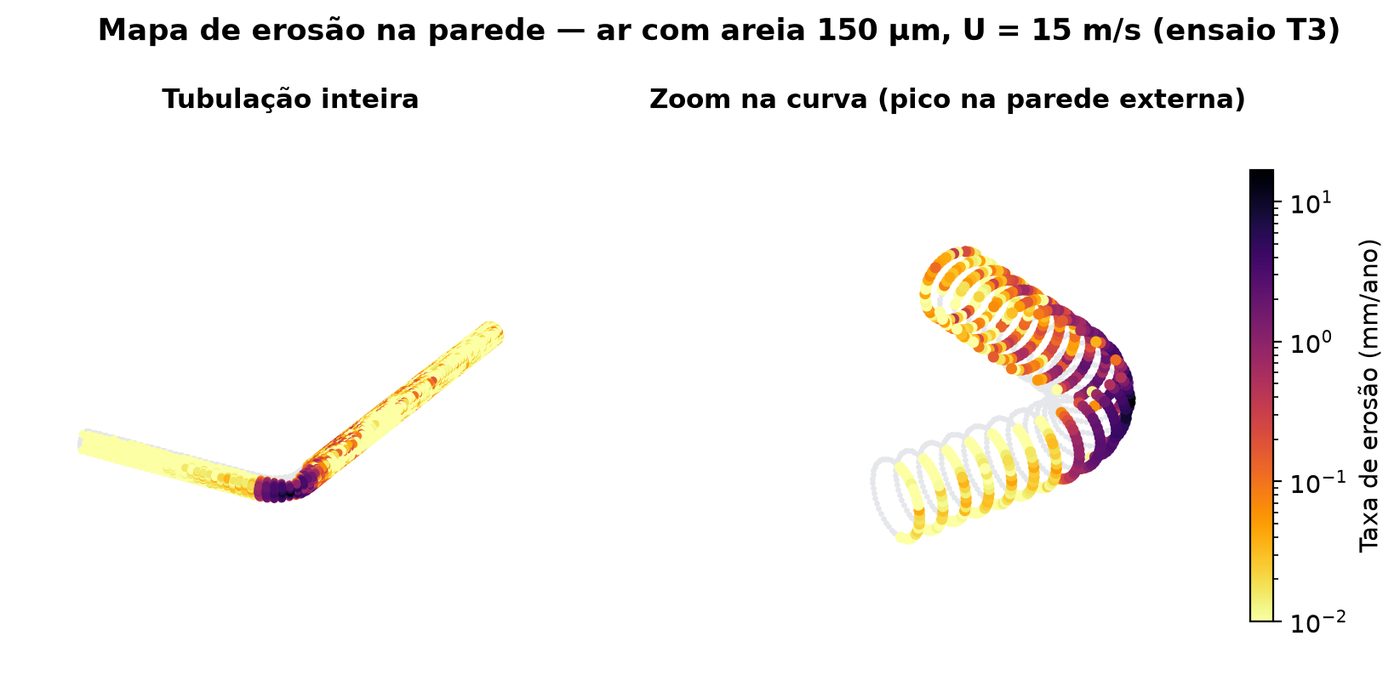
Erosion in a 90° bend: CFD validated against an open experiment
End-to-end simulation in OpenFOAM, compared against a published experiment, with an AI model trained on top.
1.05–1.49×simulated / measured erosion (target: factor of 2)
1.0%AI error on pressure drop, on new cases
Validateddetails ↓
Oil & gas · mining · pneumatic conveying
Erosion in a 90° bend: CFD validated against an open experiment
End-to-end simulation in OpenFOAM, compared against a published experiment, with an AI model trained on top.
1.05–1.49×simulated / measured erosion (target: factor of 2)
1.0%AI error on pressure drop, on new cases
The simulation landed between 1.05× and 1.49× of the erosion rate measured in the lab in the three experiments tested (Vieira et al., 2016), within the factor-of-2 criterion the industry uses to accept an erosion model. The traditional hand formula, with no CFD, came out about 100× below the measured value in the same regime. The full campaign, 32 simulations from geometry to trained model, ran in 23 minutes for less than R$0.30 of compute, and the resulting AI model answers in milliseconds, with pressure drop at 1% error on points never seen in training.
Power electronics · thermal optimization · product engineering
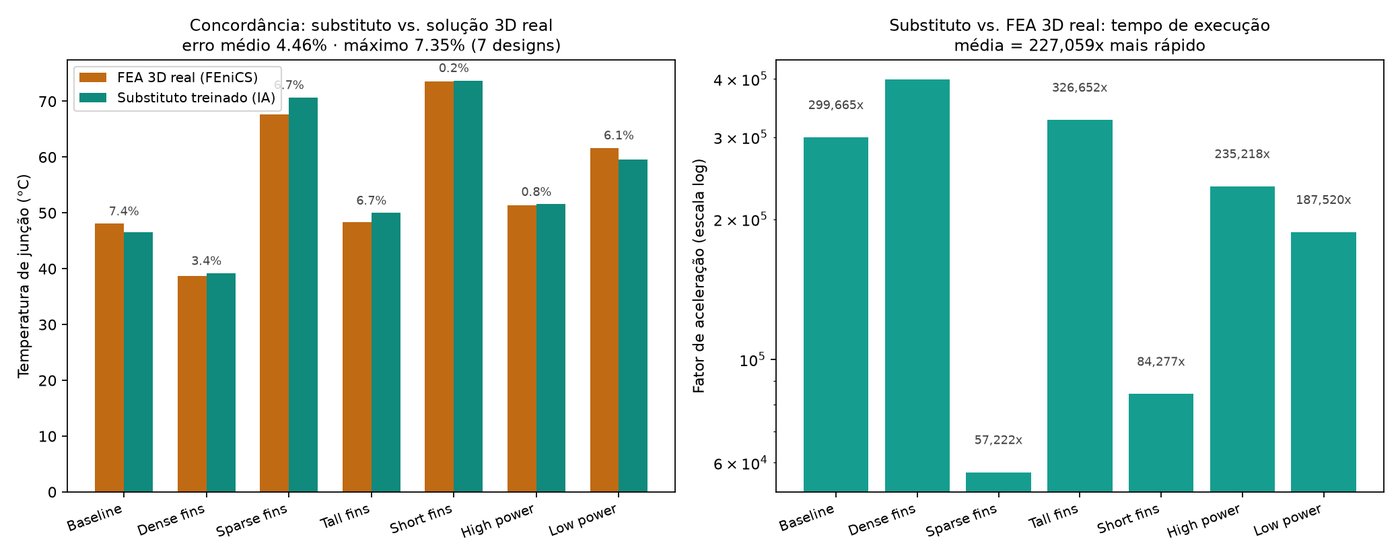
Surrogate model answers about 200,000× faster than the real 3D simulation
A trained neural network predicts the junction temperature of a heat sink in microseconds, checked every round against a real 3D FEniCS simulation.
~200,000×faster than the real 3D simulation (the exact factor depends on the machine load)
4.46%mean temperature error vs. 3D FEA (worst case: 7.35%)
Validateddetails ↓
Power electronics · thermal optimization · product engineering
Surrogate model answers about 200,000× faster than the real 3D simulation
A trained neural network predicts the junction temperature of a heat sink in microseconds, checked every round against a real 3D FEniCS simulation.
~200,000×faster than the real 3D simulation (the exact factor depends on the machine load)
4.46%mean temperature error vs. 3D FEA (worst case: 7.35%)
Seven real heat-sink geometries, deliberately different from one another (dense, sparse, tall and short fins, high and low power), each checked against a real 3D finite-element simulation (dolfinx/FEniCS, mesh via gmsh), not against another AI model. The surrogate answered in microseconds where the real simulation took 0.6 to 5.9 seconds, with temperature error within 10% in all 7 cases. The same run was repeated three times on different days: the temperature prediction is deterministic (4.46%/7.35% identical every time); only the speed-up factor changes with the machine load at the time of the test.
Aerospace · automotive · energy efficiency
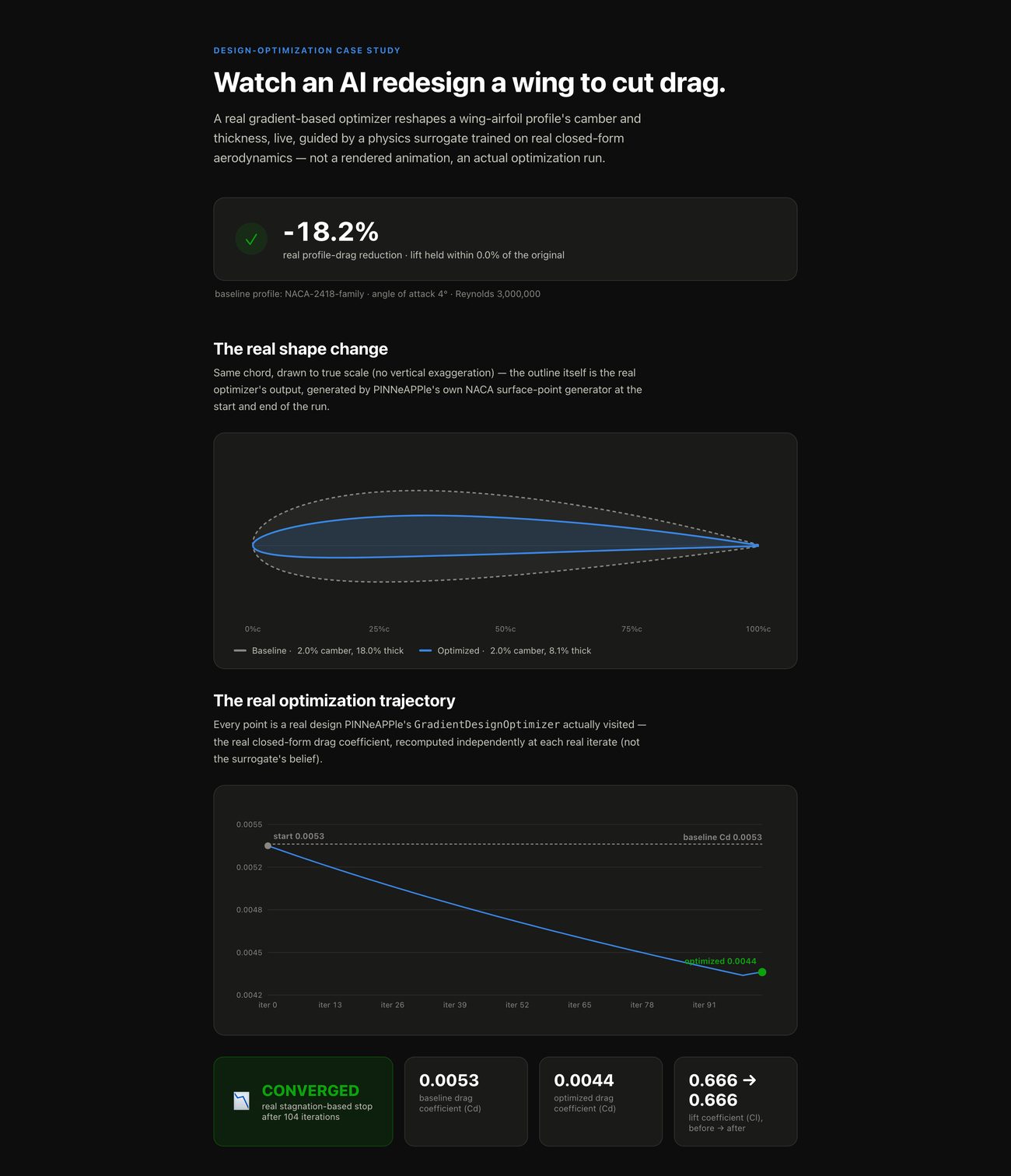
Real airfoil optimization cuts drag by 18%
A gradient optimizer guided by a model trained on the real physics of the profile, with re-verification at every step.
−18.2%profile drag
0.04%change in the target lift
Validateddetails ↓
Aerospace · automotive · energy efficiency
Real airfoil optimization cuts drag by 18%
A gradient optimizer guided by a model trained on the real physics of the profile, with re-verification at every step.
−18.2%profile drag
0.04%change in the target lift
104 real iterations of a gradient optimizer, every point of the trajectory recomputed against the physical model (not only against what the network learned), converging on a final profile inside the structural manufacturing limits. It is the same method, surrogate-guided optimization with physical re-verification at every step, that we apply to geometry in any domain: ducts, heat exchangers, structures and mechanical parts.
Automotive · aerodynamics · R&D
Vehicle aerodynamics digital twin answers in milliseconds
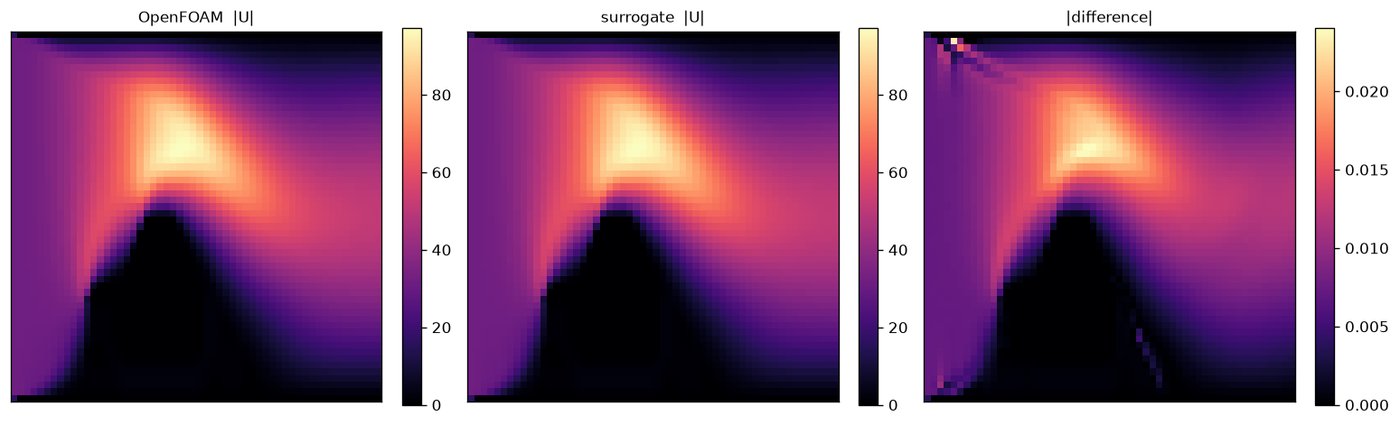
10 real OpenFOAM (simpleFoam) simulations of a car silhouette, reduced by POD and learned by a surrogate, become an interactive digital twin.
0.05%velocity-field error vs. OpenFOAM
1.3%mean error on the coefficients (Cd, Cl, velocity)
Validateddetails ↓
Automotive · aerodynamics · R&D
Vehicle aerodynamics digital twin answers in milliseconds
10 real OpenFOAM (simpleFoam) simulations of a car silhouette, reduced by POD and learned by a surrogate, become an interactive digital twin.
0.05%velocity-field error vs. OpenFOAM
1.3%mean error on the coefficients (Cd, Cl, velocity)
Ten real OpenFOAM runs between 12 and 48 m/s of relative wind, reduced to 6 POD modes (0.006% reconstruction error) and learned by a surrogate that predicts the full velocity field and the aerodynamic coefficients (Cd, Cl) at any intermediate speed never seen in training. The predicted Cd follows the real curve captured by OpenFOAM's own
forceCoeffs , including the inflection above 44 m/s, with
0.17% error specifically on Cd.
Engineering verification · mechanical design
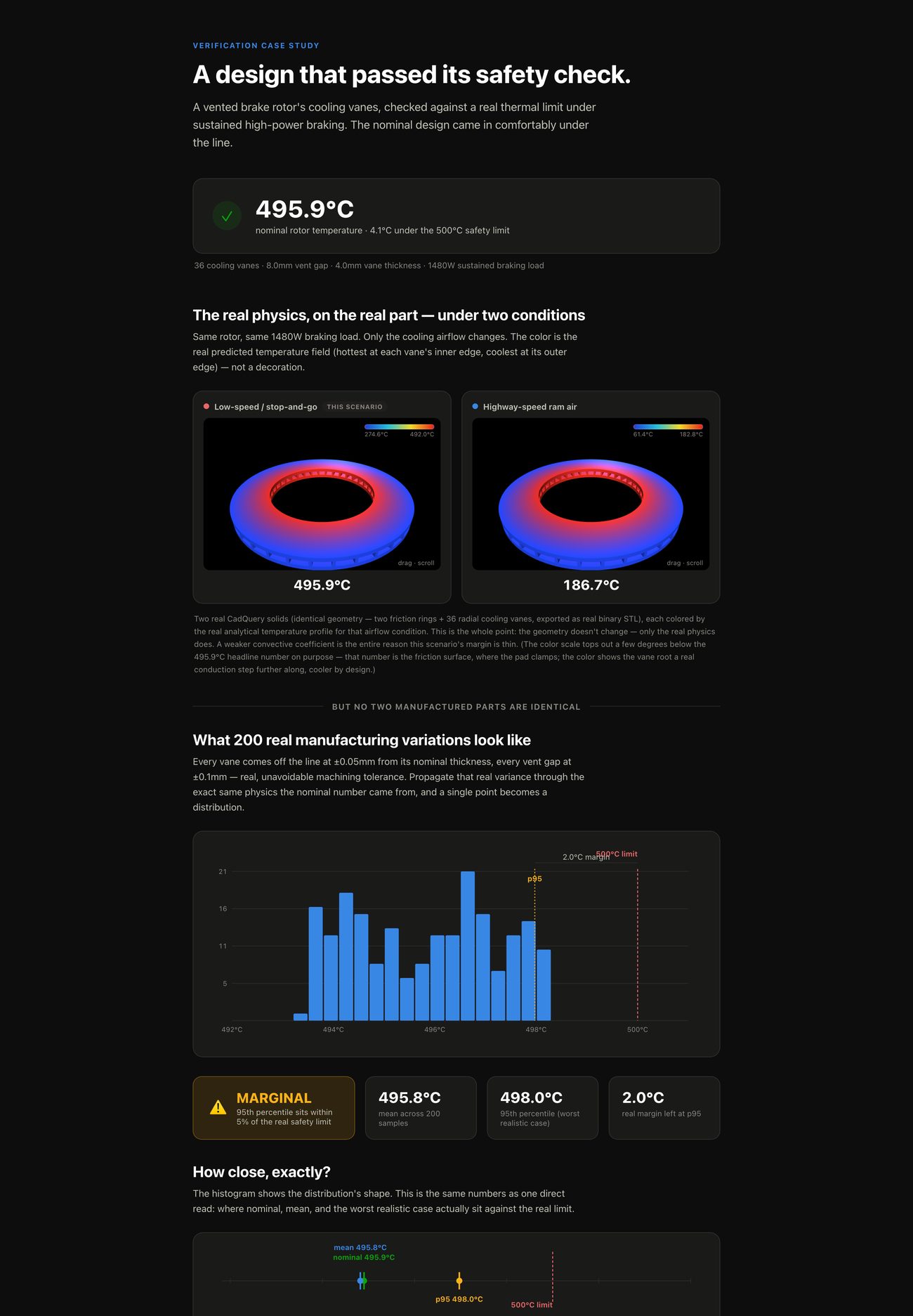
Monte Carlo reveals the real margin of an "approved" design
A brake disc passes the nominal test. The real manufacturing tolerance tells a different story.
495.9 °Cnominal (safety limit: 500 °C)
1.9 °Creal margin under manufacturing tolerance
Validateddetails ↓
Engineering verification · mechanical design
Monte Carlo reveals the real margin of an "approved" design
A brake disc passes the nominal test. The real manufacturing tolerance tells a different story.
495.9 °Cnominal (safety limit: 500 °C)
1.9 °Creal margin under manufacturing tolerance
On paper, the design had 4.1 °C of headroom to the safety limit. Propagating the real manufacturing tolerance (±0.05 mm in thickness) through 200 Monte Carlo parts, the 95th percentile reaches 498.1 °C, a real margin of only 1.9 °C. No part fails the test, but the confidence in the "approved" changes completely. This is exactly the kind of check we apply before any engineering decision leaves the screen for production.
Space robotics · agriculture · off-road machines
Rover mobility: we fixed a published AI model and recommended the classical method
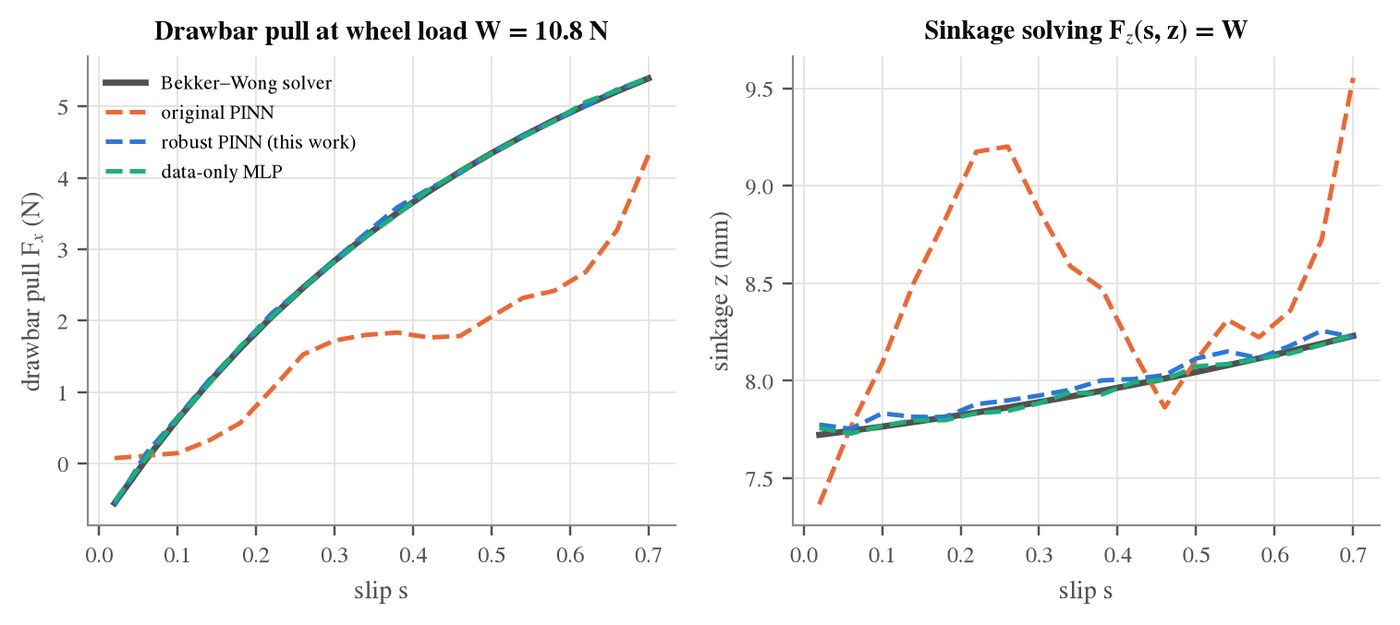
A published AI model failed physically. We diagnosed the problem, built a robust version and recommended not using it in production.
0.7–3.8%error against the reference solver
45×less traction error than the original model
Validateddetails ↓
Space robotics · agriculture · off-road machines
Rover mobility: we fixed a published AI model and recommended the classical method
A published AI model failed physically. We diagnosed the problem, built a robust version and recommended not using it in production.
0.7–3.8%error against the reference solver
45×less traction error than the original model
The corrected version reproduces the traction force of the classical physical model (Bekker–Wong) with a traction error 45× smaller than the original published version, and three physical constraints are now guaranteed by construction, not only by training. The most honest part of the work came after: the cost analysis showed that, for this specific problem, a well-implemented classical numerical method is faster and more accurate than the AI itself, and that method was our recommendation, not the flashier path. See more about that decision in Principle.
Fishing · climate · offshore energy
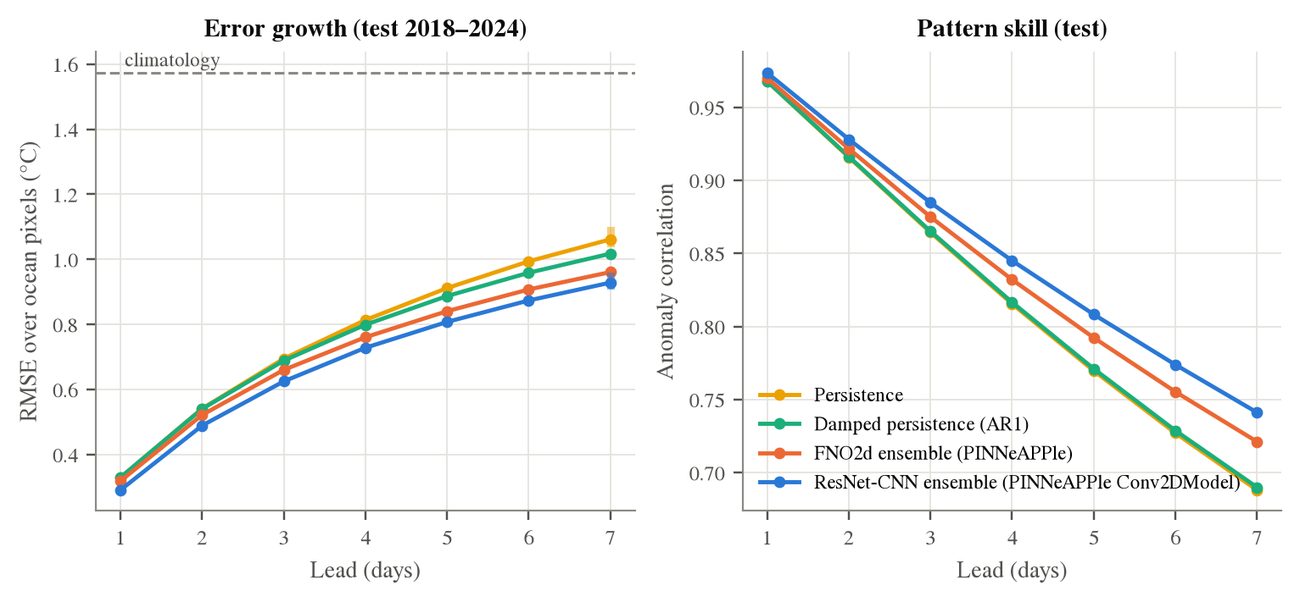
Sea-temperature forecast beats persistence at every horizon
An ensemble trained on 43 years of real satellite data, tested against the industry-standard reference.
−12%lower error at 7 days, vs. persistence
7/7horizons (1 to 7 days) where the model wins
Validateddetails ↓
Fishing · climate · offshore energy
Sea-temperature forecast beats persistence at every horizon
An ensemble trained on 43 years of real satellite data, tested against the industry-standard reference.
−12%lower error at 7 days, vs. persistence
7/7horizons (1 to 7 days) where the model wins
Tested on data never seen in training (2018–2024), in one of the most turbulent regions of the South Atlantic, the model beats persistence, the hardest reference to beat in short-term forecasting, at every horizon, from 1 to 7 days, with a confidence interval calibrated against real data. The gain is real but moderate, useful for offshore operations and fishing, not a promise of perfect accuracy.
Fluids lab · wind tunnel · R&D
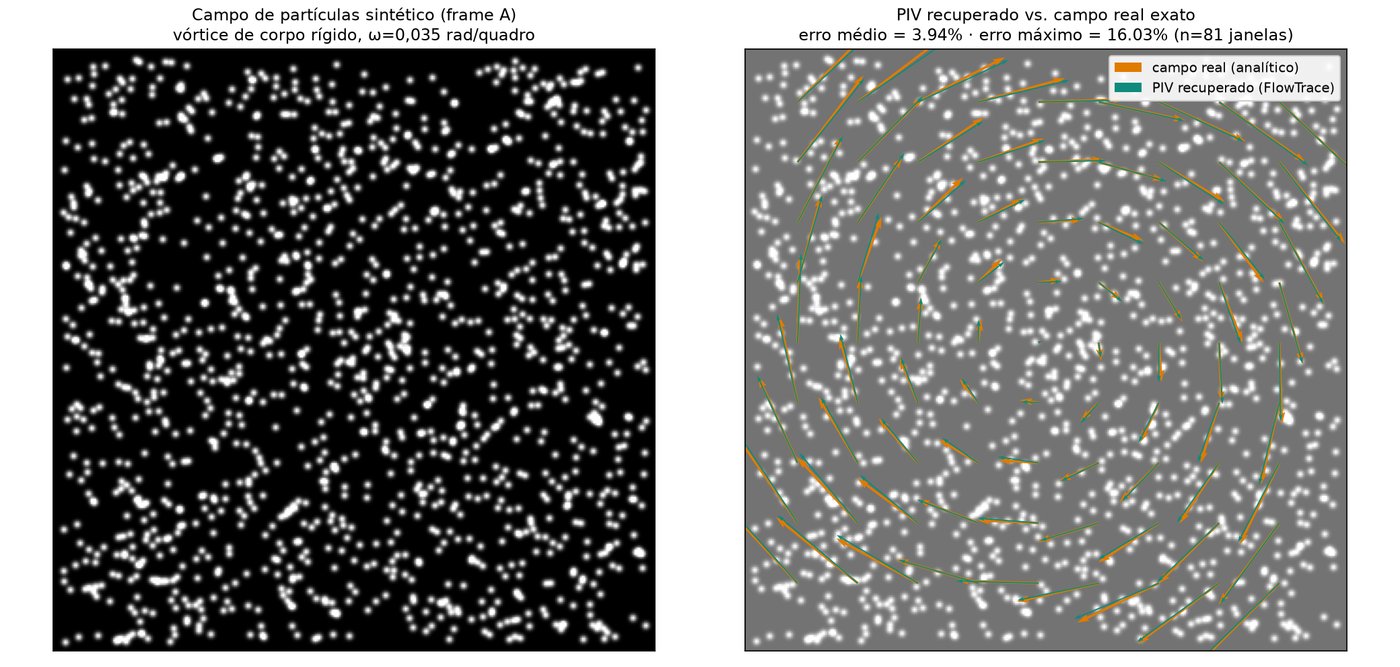
Software PIV recovers a vortex field with 3.9% error
A synthetic particle-image pair, a vortex field with an exact analytical solution, processed by the same cross-correlation algorithm that runs in production.
3.94%mean relative error vs. the exact analytical field
81velocity vectors recovered in a single pass
Validateddetails ↓
Fluids lab · wind tunnel · R&D
Software PIV recovers a vortex field with 3.9% error
A synthetic particle-image pair, a vortex field with an exact analytical solution, processed by the same cross-correlation algorithm that runs in production.
3.94%mean relative error vs. the exact analytical field
81velocity vectors recovered in a single pass
Each synthetic particle was displaced by the exact rotation matrix of a rigid-body vortex, not by an image approximation, so the reference carries no discretization error of its own. Running the real cross-correlation algorithm (the same one that serves the production endpoint) on the image pair, the recovered vectors reproduce the rotational structure of the flow with 3.94% mean error and 16% at the worst point (near the vortex centre, where the true velocity tends to zero), with no camera hardware, laser or proprietary software, just video and processing.
CAD/CAE · interoperability · data engineering
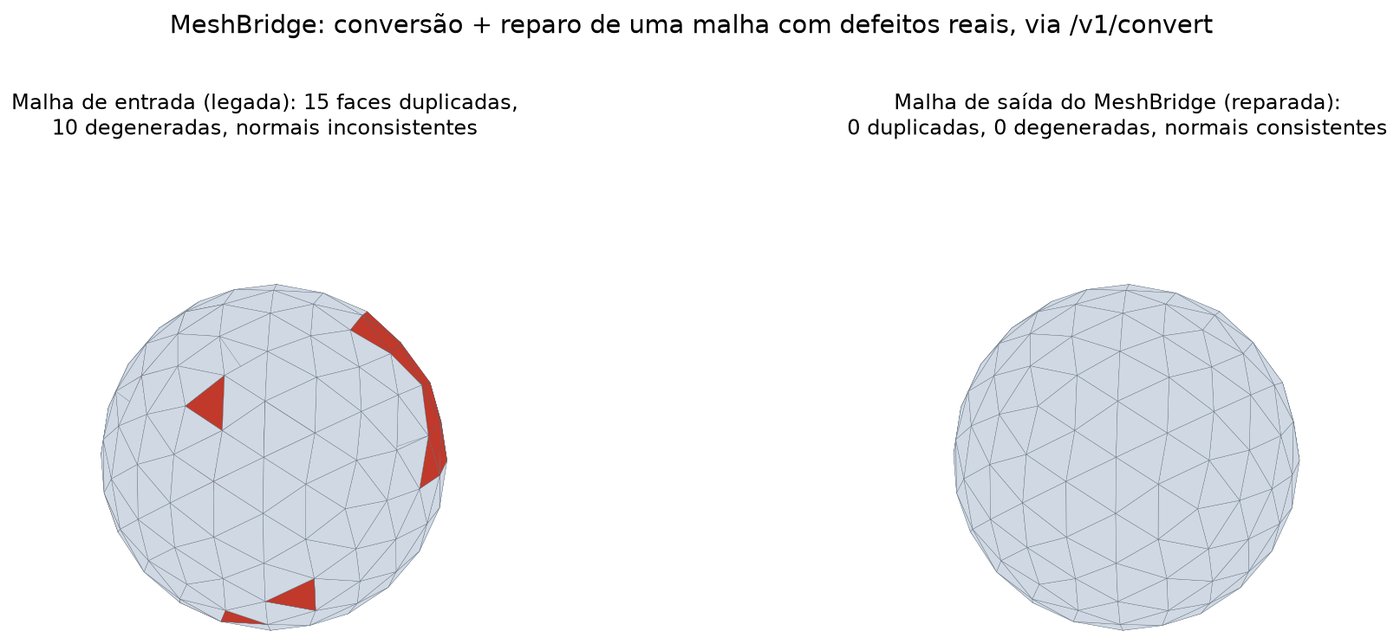
Mesh converter removes 100% of the defects of a legacy export
A mesh with typical legacy-export defects (duplicate faces, degenerate faces, flipped normals) processed by the real conversion and repair endpoint.
25/25defective faces removed (duplicate + degenerate)
100%consistent normals after the repair
Validateddetails ↓
CAD/CAE · interoperability · data engineering
Mesh converter removes 100% of the defects of a legacy export
A mesh with typical legacy-export defects (duplicate faces, degenerate faces, flipped normals) processed by the real conversion and repair endpoint.
25/25defective faces removed (duplicate + degenerate)
100%consistent normals after the repair
A real mesh was deliberately damaged the way legacy CFD/CAD exports usually arrive: 15 exact duplicate faces, 10 degenerate (zero-area) faces and 20 faces with flipped normals. Run through the real HTTP conversion endpoint with repair enabled, the result had zero duplicate faces, zero degenerate faces and consistent normals : all three checks passing against the production endpoint, not an isolated simulation. Honest note: the automatic repair does not fill holes by default today, it only removes duplicates/degenerates and fixes normals. That is exactly what is live, nothing more.
Wind energy · turbomachinery
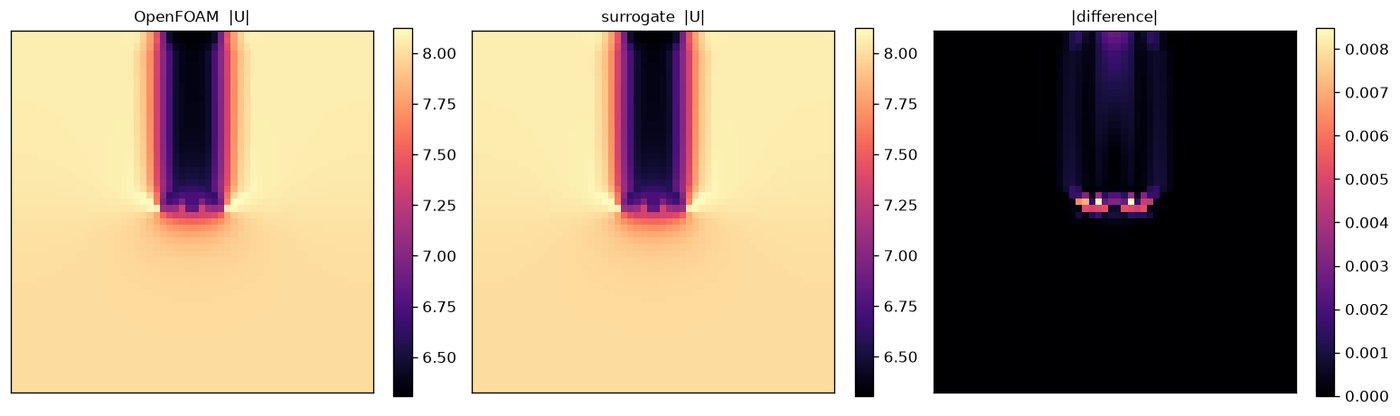
Wind-rotor digital twin predicts wake, thrust and torque
9 real actuator-disc simulations of a rotor in OpenFOAM, covering 200 to 2,300 RPM, learned by a surrogate that predicts the wake field and the three operating scalars.
0.24%wake-field error vs. OpenFOAM
0.9%mean error on thrust, power and torque
Validateddetails ↓
Wind energy · turbomachinery
Wind-rotor digital twin predicts wake, thrust and torque
9 real actuator-disc simulations of a rotor in OpenFOAM, covering 200 to 2,300 RPM, learned by a surrogate that predicts the wake field and the three operating scalars.
0.24%wake-field error vs. OpenFOAM
0.9%mean error on thrust, power and torque
Nine real runs of OpenFOAM's actuator-disc rotor case (blade-element momentum model, a single reused mesh), each varying only the rotation speed. Thrust, power and torque come from actuator-disc momentum theory applied to the truly resolved wake, not from a solver-native writer. The surrogate reproduces both the wake field and the three scalars with less than 1% mean error, at any rotation speed between the simulated points.
Chemical processes · pharma · industrial mixing
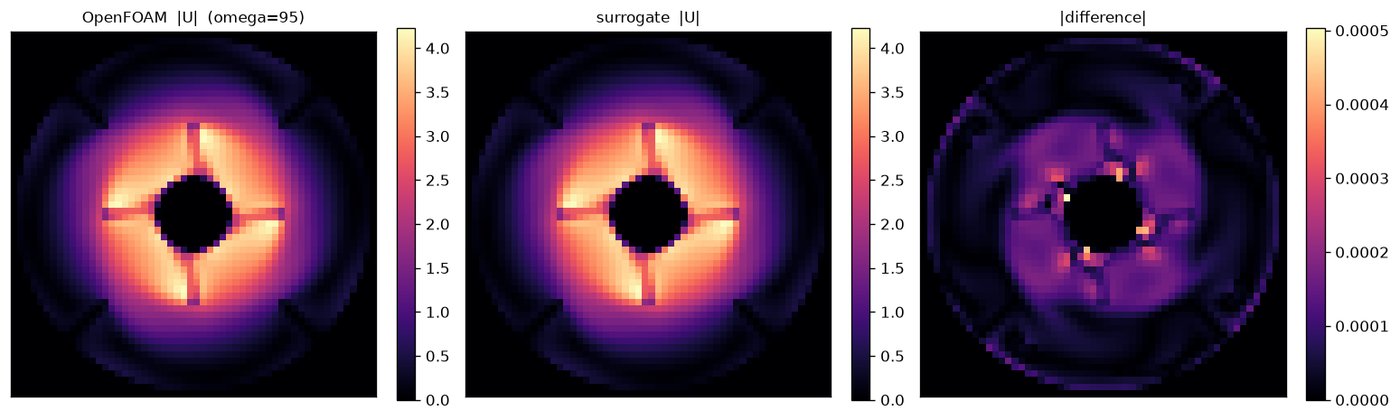
Stirred-tank digital twin gets the known physical scaling law right
10 real OpenFOAM (MRF) simulations of a stirred tank, covering 15 to 190 rad/s, with the surrogate recovering the known power-vs-speed physics.
0.01%velocity-field error vs. OpenFOAM
1.9%mean error on the scalars (power, Re, TKE)
Validateddetails ↓
Chemical processes · pharma · industrial mixing
Stirred-tank digital twin gets the known physical scaling law right
10 real OpenFOAM (MRF) simulations of a stirred tank, covering 15 to 190 rad/s, with the surrogate recovering the known power-vs-speed physics.
0.01%velocity-field error vs. OpenFOAM
1.9%mean error on the scalars (power, Re, TKE)
Ten real OpenFOAM runs with a moving reference frame (MRF) of a stirred tank, from 15 to 190 rad/s of impeller rotation. Physically, the sweep recovers power ∝ ω^2.7, very close to the classical law for turbulent stirred tanks (P ∝ ρN³D⁵), a sign that the surrogate learned the real physics of the problem, not just how to interpolate points. The predicted velocity field reproduces even the wake of each of the impeller's 4 blades, with 0.01% error.
Data-science teams · AI model operations
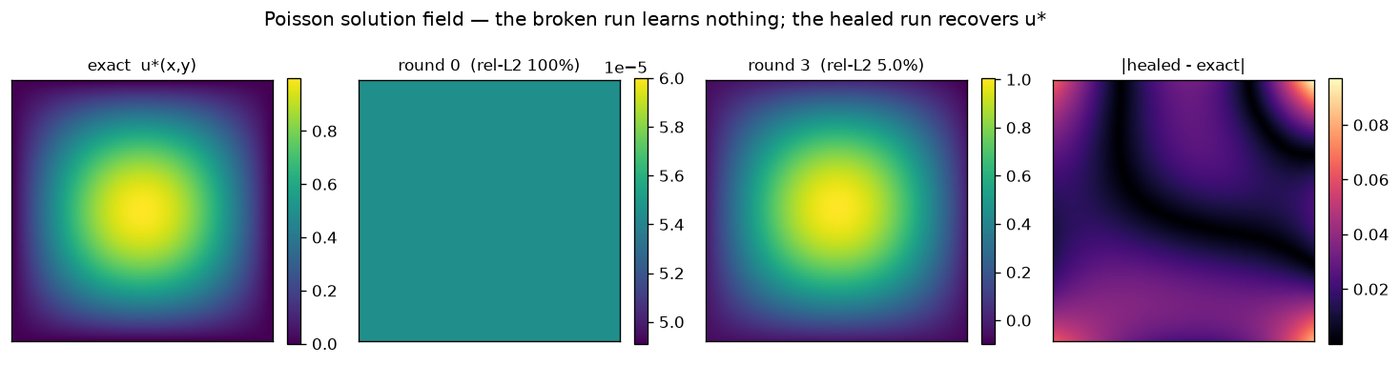
Training copilot diagnoses and fixes a broken model on its own
A physics-informed neural network launched with a bad configuration is automatically diagnosed and corrected in 4 rounds, with no human intervention.
100%→5%real error against the exact solution, in 4 rounds
17stotal diagnosis and correction time, on CPU
Validateddetails ↓
Data-science teams · AI model operations
Training copilot diagnoses and fixes a broken model on its own
A physics-informed neural network launched with a bad configuration is automatically diagnosed and corrected in 4 rounds, with no human intervention.
100%→5%real error against the exact solution, in 4 rounds
17stotal diagnosis and correction time, on CPU
Round 0 learns nothing, 100% error against the exact solution of a Poisson problem with a known answer. An automatic diagnoser reads the loss history, classifies the cause (plateau, oscillation, imbalance between physics and boundary condition) and proposes the next configuration change. Four rounds later, with no human intervention, the real error drops to 5%, a reduction of 20×. It is the same logic, at scale, behind our operational copilot service: memory of past episodes guiding the next decision, with explicit confidence about what changed.
Automotive · structures · vehicle safety
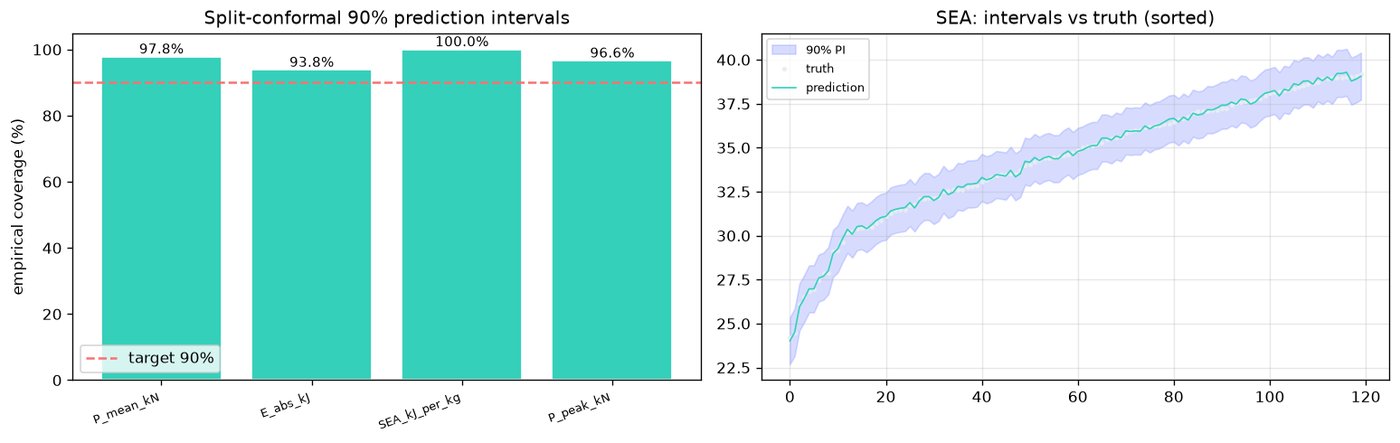
A crash surrogate's confidence interval hits the statistical target
A crash energy-absorption surrogate, transferred between vehicle programs, with prediction intervals that really cover what they promise.
1.7–2.5%error after SUV → sedan transfer
94–100%real coverage of the promised 90% intervals
Validateddetails ↓
Automotive · structures · vehicle safety
A crash surrogate's confidence interval hits the statistical target
A crash energy-absorption surrogate, transferred between vehicle programs, with prediction intervals that really cover what they promise.
1.7–2.5%error after SUV → sedan transfer
94–100%real coverage of the promised 90% intervals
A surrogate trained on the physics of progressive collapse of thin-walled tubes (Abramowicz–Jones model) for an SUV program generalizes poorly to a sedan without adjustment (17–32% error, as expected when the regime changes), but after transfer fine-tuning with 180 sedan samples, the error drops to 1.7–2.5%. More importantly: the 90% prediction intervals built by conformal prediction really cover the true value between 94% and 100% of the time, not an invented confidence number: the same statistical honesty we apply in any verification before an engineering decision.
Climate · energy · agriculture · civil defence
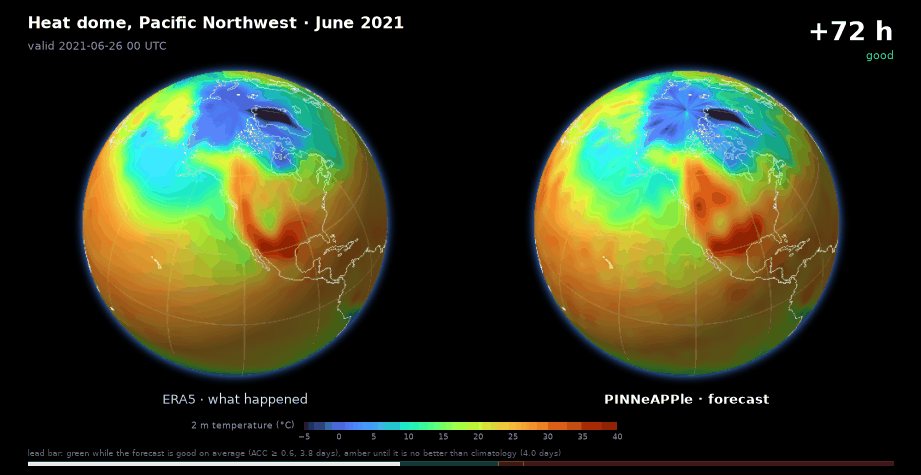
Global weather forecast: 5.6 days of useful forecast already in the first training phase
Global model trained on 33 years of public reanalysis (ERA5) and compared, on the same 2020 forecasts, with IFS HRES, Pangu-Weather and NeuralGCM. Experiment in progress: result of the first training phase.
5.6 daysof useful forecast (z500, correlation ≥ 0.6), against 1.4 days for persistence
9.1–9.6 daysfor the reference models: the distance the next training phases still have to close
In progressdetails ↓
Climate · energy · agriculture · civil defence
Global weather forecast: 5.6 days of useful forecast already in the first training phase
Global model trained on 33 years of public reanalysis (ERA5) and compared, on the same 2020 forecasts, with IFS HRES, Pangu-Weather and NeuralGCM. Experiment in progress: result of the first training phase.
5.6 daysof useful forecast (z500, correlation ≥ 0.6), against 1.4 days for persistence
9.1–9.6 daysfor the reference models: the distance the next training phases still have to close
This is an honest preview. Training has phases; only the first (6-hour step, about 2 hours on 4 CPU cores) is done. The rollout phases, which carry the skill beyond 3 to 5 days, have not run yet. So, over 21 forecasts of 2020, the 500 hPa geopotential error at day 3 is 397 m²/s² (RMSE), against 104–125 for the reference models, and persistence errs by 923. Even so, the model already reproduces the structure of the Pacific Northwest heat dome (June 2021) three days ahead: on the right, the forecast; on the left, what happened. The same time-step forecasting base serves any field that evolves (wind, waves, process temperature), always with the useful horizon measured against persistence and climatology, not promised.
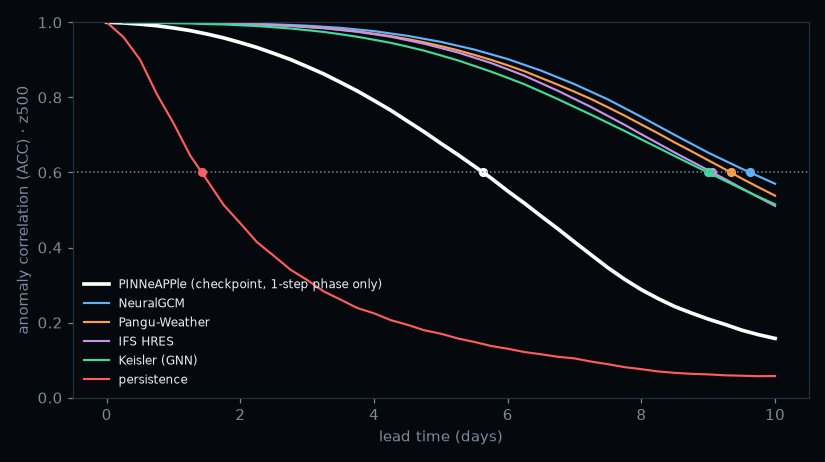
Data: ERA5 reanalysis from the Copernicus Climate Change Service (C3S), read through WeatherBench2. Contains modified Copernicus Climate Change Service information; neither the European Commission nor ECMWF is responsible for any use of it. The published models' forecasts come from WeatherBench2; only their scores are used here.
Digital twins · multiphysics simulation · operation without a reference
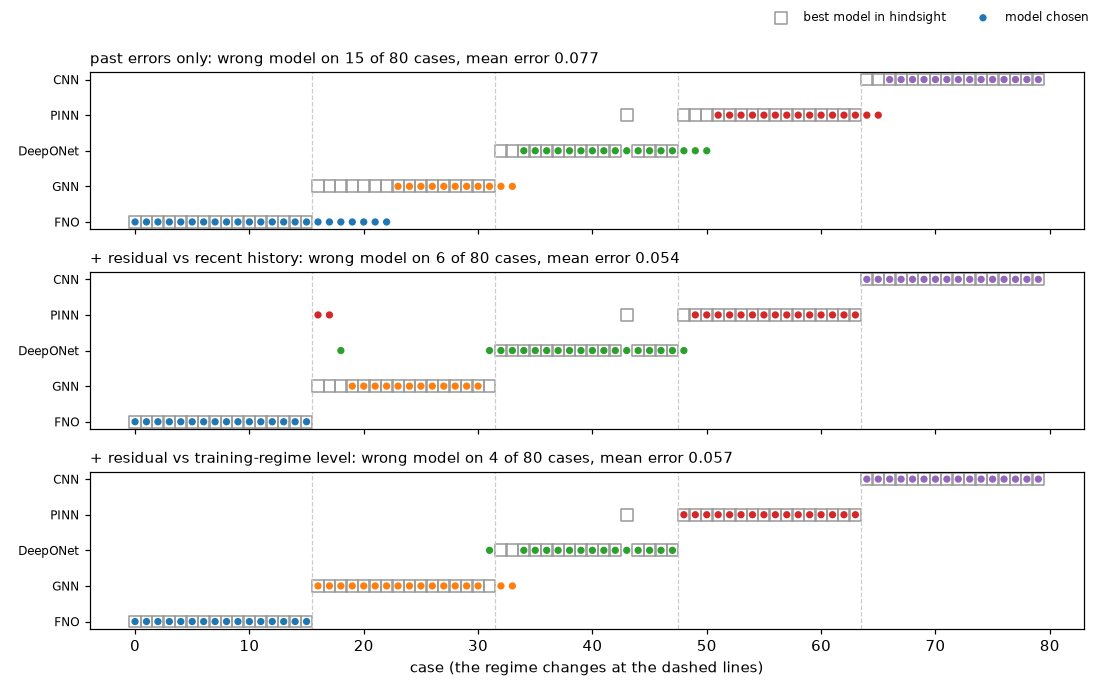
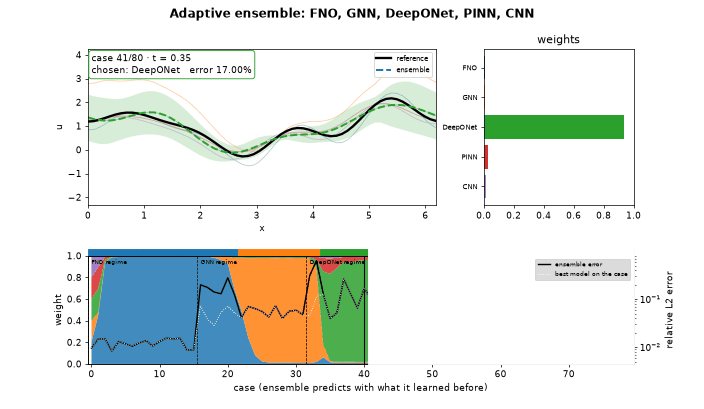
An adaptive ensemble of five physics model families errs about 3× less than the best single model
FNO, graph network, DeepONet, PINN and CNN in the same ensemble, each trained on a different regime. The ensemble picks the right model for each case, using only what it has already seen.
7.8%error over the whole stream of 80 cases, against 24% for the best single model
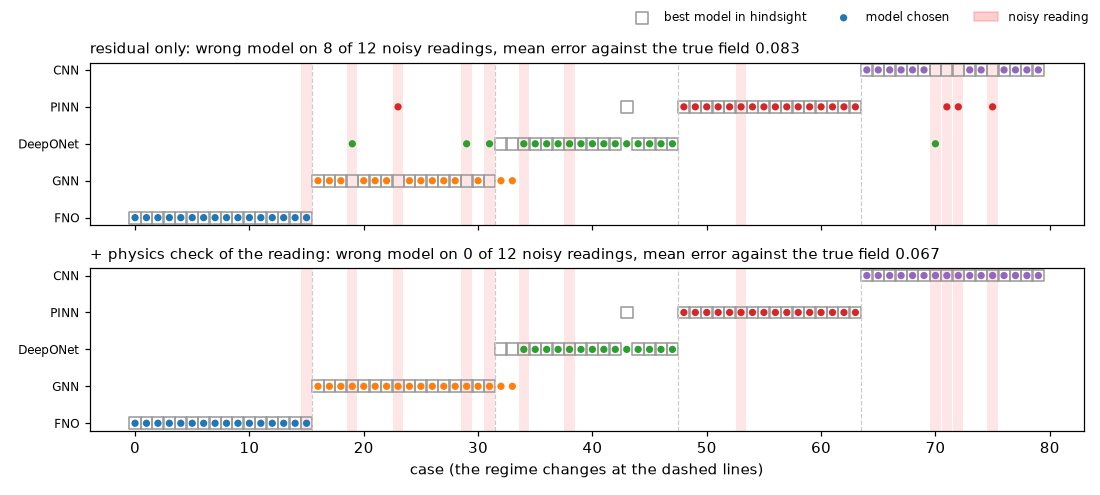
0 of 12noisy sensor readings fooled the ensemble with the physics check (8 of 12 without it)
Validateddetails ↓
Digital twins · multiphysics simulation · operation without a reference
An adaptive ensemble of five physics model families errs about 3× less than the best single model
FNO, graph network, DeepONet, PINN and CNN in the same ensemble, each trained on a different regime. The ensemble picks the right model for each case, using only what it has already seen.
7.8%error over the whole stream of 80 cases, against 24% for the best single model
0 of 12noisy sensor readings fooled the ensemble with the physics check (8 of 12 without it)
The problem is advection and diffusion with an exact solution, so the error is measured against the right answer and not against another model. The 80-case stream goes through five regimes; no single model covers them all. The ensemble switches to the right family 2 to 6 cases after each regime change and, also looking at the physics residual of the current case before predicting, picks the wrong model in 4 of 80 cases, against 15 of 80 looking only at past errors. The 90% intervals covered 90% of the points. Stated limit: it is a one-dimensional reference problem, not yet an industrial case, and the physics residual detects failure but does not rank the most accurate model. In operation, the gain is the same reasoning applied to expensive simulations: the cheap model while it serves, the solver when it stops serving.